Aiva makes full copyright depend on the subscription tier
Aiva's legal terms make copyright ownership and monetisation of a generated track depend on which paid plan made it.
- Site publication
- September 18, 2026
What happened
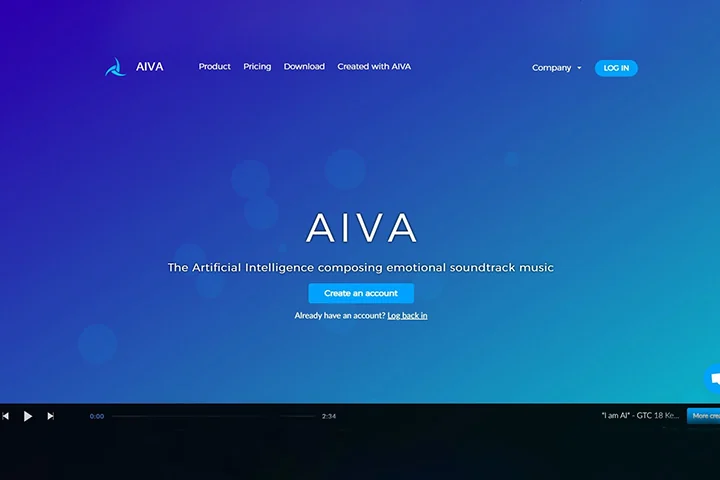
Aiva is a composition tool that generates instrumental tracks in a chosen style, which a user can then edit, extend with uploaded audio or MIDI influences, and export. The company's copyright notice, visible across its site and read on 16 September 2026, marks material as 'Copyright © 2016-2026 Aiva Technologies SARL', consistent with the company operating since 2016, though the current pages do not themselves narrate a founding history or a specific registration event.
What the documents say
Aiva's pricing page ties the legal status of a generated track directly to the plan that made it. On the Free plan, the page states 'Copyright owned by AIVA' with 'No monetization'; on Standard, copyright remains 'owned by AIVA' but the plan permits 'Limited monetization', restricted by the terms to a small set of named platforms. Only the Pro plan states 'Copyright owned by YOU' with 'Full monetization'. The legal agreement spells out the mechanism behind the labels: three licence categories, a 'non-commercial license', a 'Limited Commercial License' naming 'Youtube, Twitch, Tik Tok and Instagram' specifically, and a full transfer of 'all copyrights of the MIDI and/or Audio Composition to Licensee', stating that 'the type of the License granted to Licensee upon download will depend on the plan that User is currently subscribed to.'
Why it matters for makers
The mechanism is a contract grant, not a copyright determination: Aiva's terms describe what Aiva will assign or license to a user, a separate question from whether the output is protected by copyright at all, or who a court would recognise as author of an AI-assisted composition. A track generated on a lower tier is not simply 'unlicensed'; it is licensed narrowly, for non-commercial use or a named list of platforms, with copyright staying with Aiva under the terms as written. Downgrading a subscription after release is not addressed on these pages, worth checking directly with the company for any specific release.
What to check before you use it
Confirm which plan was active when a specific track was generated and downloaded, since the terms tie the licence to the plan at that time, not necessarily your current one. If a track needs a platform outside the Standard plan's named list, that use is not covered by the 'Limited Commercial License' as described. Before treating a composition as fully yours for any purpose, including registering it elsewhere, check that the download came from a Pro plan, since only that tier states 'Copyright owned by YOU'. This is a reading of the published terms, not legal advice.
- Which Aiva plan was active when the specific track you want to use was generated?
- Does your intended use fall inside the named platforms of a Limited Commercial License, or beyond it?
- If you need full ownership, do you have documentation that the download came from the Pro tier?
A composition tool that states its licence terms by plan, in writing, is unusually explicit about a question many generators leave vague; the trade-off is that a maker has to track which plan produced which file, not just that a file exists.
Sources & reading trail
States which plans grant AIVA or user copyright ownership and what monetisation each allows.
Source published: Not established · Retrieved: 16 September 2026
Defines the three licence categories and states the licence granted depends on the subscribed plan.
Source published: Not established · Retrieved: 16 September 2026
Copyright notice dating company material from 2016, as retrieved.
Source published: Not established · Retrieved: 16 September 2026
Papers, terms and official documents establish the record; the maker reading and the checks are Signal to Song editorial analysis. This retrospective draft does not imply the site published on the event date.
Continue reading
- Music’s AI credit standard is still being built by DDEX
- Suno assigns song ownership only on its paid tiers
- Browse the complete the archive
Sources & reading trail
- Pricing
Retrieved: September 16, 2026 - Legal Agreement
Retrieved: September 16, 2026 - About
Retrieved: September 16, 2026
The documents above establish the record. The reading and the questions are this publication’s editorial analysis, written after the fact.
Published September 18, 2026, not on the date of the event described.