Tennessee made voice a protected property right against AI clones
The ELVIS Act, signed March 2024 and effective 1 July 2024, added voice to Tennessee's right-of-publicity statute and reaches cloning tools.
- Historical event
- March 21, 2024
- First source published
- March 22, 2024
- Site publication
- September 18, 2026
What happened
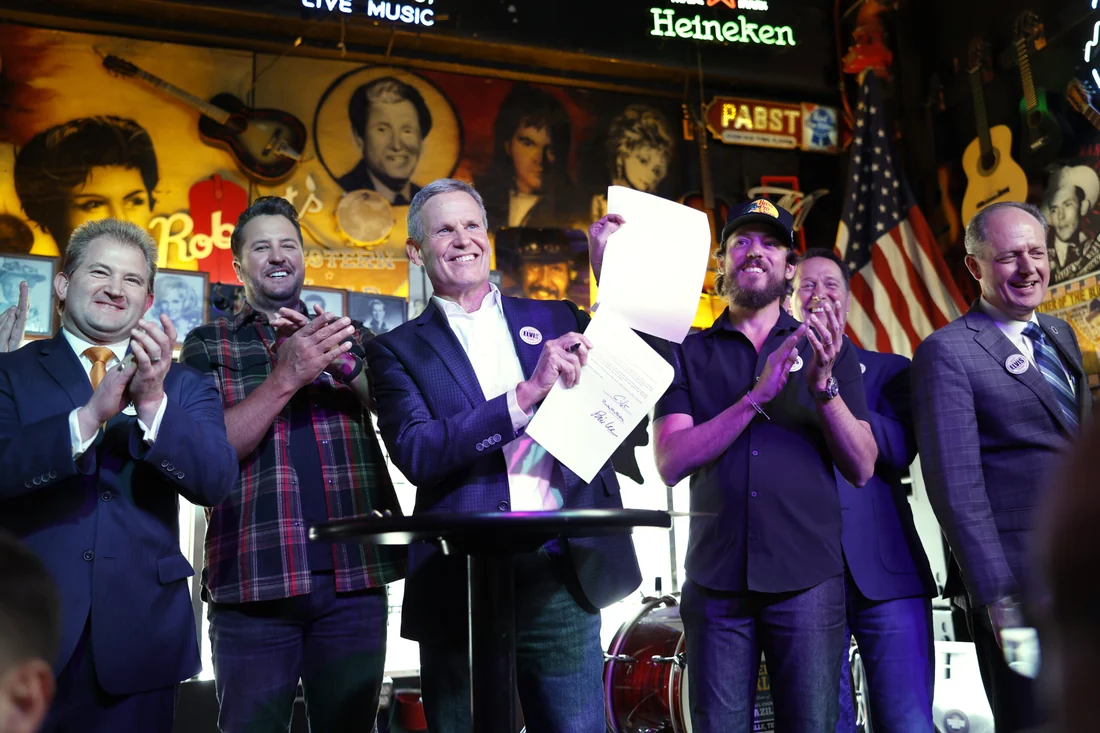
On 21 March 2024, Tennessee Governor Bill Lee signed the Ensuring Likeness Voice and Image Security (ELVIS) Act at a Nashville press event, according to a contemporaneous release from the Recording Industry Association of America, published alongside RIAA Chairman Mitch Glazier and performers Luke Bryan and Chris Janson. The bill had passed the state House 93-0 and the Senate 30-0 earlier that month. The enacted text, Public Chapter 588, amends Tennessee's existing 1984 personal-rights statute and states that the act 'takes effect July 1, 2024, the public welfare requiring it'.
What the documents say
Public Chapter 588's enacted text, filed with the Tennessee Secretary of State, adds a definition: 'voice' means 'a sound in a medium that is readily identifiable and attributable to a particular individual, regardless of whether the sound contains the actual voice or a simulation of the voice'. It rewrites the underlying property right so that 'every individual has a property right in the use of that individual's name, photograph, voice, or likeness', and creates liability not only for unauthorised use of a voice but for distributing 'an algorithm, software, tool, or other technology' whose primary purpose is producing an identifiable person's voice or likeness without authorisation — reaching the tool, not only the finished recording. The legislature's own bill record confirms the unanimous votes and a formal governor's-signature date of 26 March 2024, a few days after the public signing event RIAA describes.
Why it matters for makers
The Act's reach into 'software, tool, or other technology' is the detail worth naming: it is not limited to whoever uploads a finished fake, but extends potential liability to whoever knowingly distributes a cloning tool built around one identifiable person's voice. For a producer working with any voice-conversion or singing-synthesis tool, the practical boundary is authorisation, not technical capability — the statute does not care whether the simulation is convincing, only whether the person behind the voice consented.
What to check before you use it
A maker working with a Tennessee-connected artist, or building a tool marketed around a specific voice, should confirm in writing that the voice's owner has authorised the specific use, keep that authorisation on file, and treat the statute's fair-use carve-outs — news, comment, satire, and self-representation that does not create a false impression of an authentic recording — as narrow rather than a general licence. This is an editorial reading of the statute, not a substitute for legal advice.
- Does the authorisation on file cover this specific recording, or only a general prior arrangement?
- Would the finished use plausibly be mistaken for an authentic recording the person made?
- If distributing a voice-cloning tool, is it built around one identifiable person or general-purpose?
Tennessee was the first state to name voice and cloning tools this explicitly, and the RIAA's presence at the signing reflects an industry that had lobbied for exactly this language; makers elsewhere should expect similar statutes to spread state by state rather than wait for a single federal standard.
Sources & reading trail
Contemporaneous industry account of the Nashville signing event, quoting RIAA's chairman and performers present.
Source published: 22 March 2024 · Retrieved: 16 September 2026
The enacted statutory text: voice definition, property right, tool-distribution liability and 1 July 2024 effective date.
Source published: Not established · Retrieved: 16 September 2026
The legislature's own record of unanimous votes, the Public Chapter 588 assignment and the formal signature date.
Source published: Not established · Retrieved: 16 September 2026
Papers, terms and official documents establish the record; the maker reading and the checks are Signal to Song editorial analysis. This retrospective draft does not imply the site published on the event date.
Continue reading
- A federal bill would give Americans a property right in their voice
- Randy Travis used AI to sing again with his own consent
- A voice clone’s consent has to satisfy a statute and a platform
- Browse the complete the archive
Sources & reading trail
- ELVIS Act Becomes Law as Tennessee Leads the Nation
Source published: March 22, 2024 · Retrieved: September 16, 2026 - Public Chapter No. 588 (House Bill No. 2091)
Retrieved: September 16, 2026 - Bill Information: HB2091 (113th General Assembly)
Retrieved: September 16, 2026
The documents above establish the record. The reading and the questions are this publication’s editorial analysis, written after the fact.
Published September 18, 2026, not on the date of the event described.