Deezer began tagging albums that are fully AI-generated
Deezer's own announcements document a detection tool, a June 2025 tagging system, and the rising delivery share it says the tool measures.
- Historical event
- June 20, 2025
- First source published
- January 24, 2025
- Site publication
- September 18, 2026
What happened
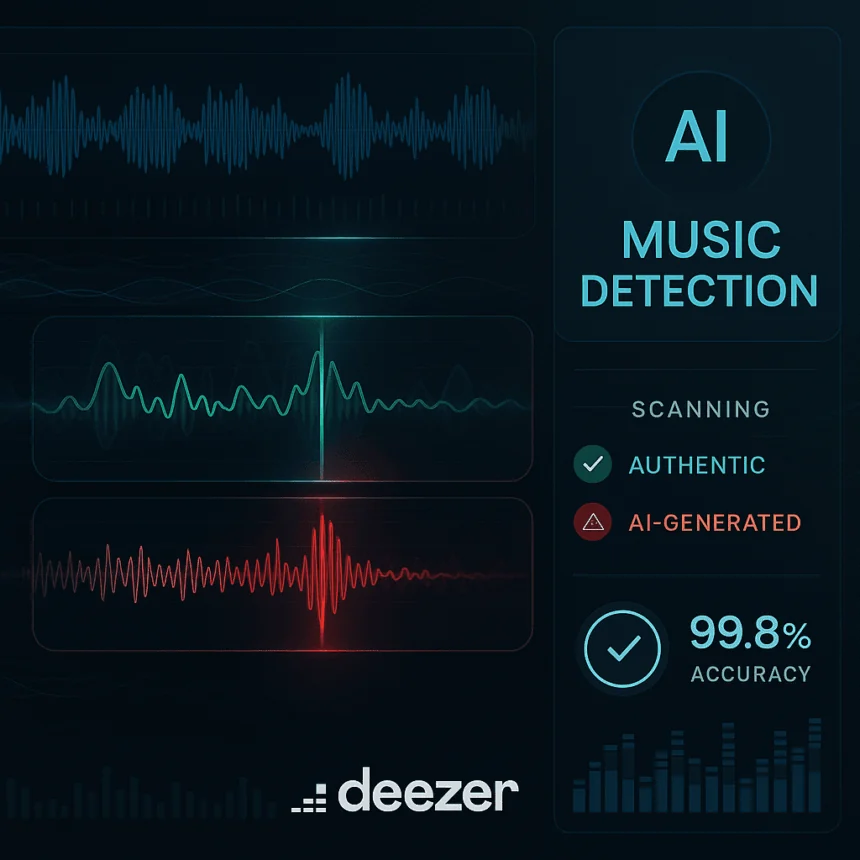
On 24 January 2025, Deezer announced it had deployed an AI music detection tool, reporting that around 10% of tracks delivered daily were fully AI-generated. On 20 June 2025, Deezer announced it had launched what it calls the world's first AI tagging system for music streaming, marking albums that contain fully AI-generated tracks and stating the daily fully-AI share had reached 18%, more than 20,000 tracks. By 11 September 2025, a further Deezer release stated the figure had reached 28% of daily delivered tracks, over 30,000 a day.
What the documents say
Deezer's own releases are explicit about what the percentage measures: it is a share of daily track delivery to the platform, not of streams or of the existing catalogue. The June release states that fully AI-generated content accounts for “approximately 0.5%” of Deezer streams, while “up to 70%” of the streams that fully AI-generated tracks do receive are, in Deezer's assessment, fraudulent. The company states it excludes confirmed manipulation from royalty payments and removes fully AI-generated tracks from algorithmic and editorial recommendations, without removing them from the catalogue or from search. CEO Alexis Lanternier is quoted describing AI as “not inherently good or bad” while calling transparency “key to building trust.”
Why it matters for makers
The mechanism separates upload volume from listener attention: a huge share of delivered tracks can be fully generated while representing a tiny fraction of actual plays, because most of that delivery is never streamed at all. Deezer's own framing ties the delivery surge to fraud rather than to listener demand for generated music. For a maker who legitimately uses generative tools, the practical consequence is exclusion from recommendation surfaces for any track Deezer's tool flags as fully AI-generated, regardless of whether that specific track was involved in manipulation.
What to check before you use it
This is an editorial reading of Deezer's own statements. If a release contains any human contribution, current Deezer language on “fully AI generated” suggests it targets tracks with none, so partial use may sit outside the tag, though Deezer has not published the detection threshold. Expect exclusion from algorithmic and editorial playlisting for any tagged track, independent of royalty eligibility. Because the patents behind the detector are still pending as Deezer describes them, treat any specific detection claim as provisional rather than settled.
- Does your track contain any human-performed or human-produced element that would place it outside a “fully AI generated” tag?
- Are you relying on algorithmic or editorial placement for discovery, and would a tag remove that route for this release?
- Have you checked Deezer's most recent published delivery-share figure before citing an older one as current?
Deezer presents its rising percentages as a delivery and fraud story rather than a listening one, and any citation of its figures should keep that distinction, and the reporting period each figure covers, intact.
Sources & reading trail
Establishes the detection tool's launch and the initial ~10% daily delivery figure.
Source published: 24 January 2025 · Retrieved: 16 September 2026
Announces the tagging system, the 18% delivery figure, the 0.5% stream share, and the 70% fraud estimate.
Source published: 20 June 2025 · Retrieved: 16 September 2026
Updates the delivery-share figure to 28% and restates the recommendation-exclusion policy.
Source published: 11 September 2025 · Retrieved: 16 September 2026
Papers, terms and official documents establish the record; the maker reading and the checks are Signal to Song editorial analysis. This retrospective draft does not imply the site published on the event date.
Continue reading
- Spotify set new rules on AI voice clones, spam and disclosure
- The Velvet Sundown went viral before its AI origin was confirmed
- Open models show two ways to disclose training data
- Browse the complete the archive
Sources & reading trail
- Deezer deploys cutting-edge AI detection tool for music streaming
Source published: January 24, 2025 · Retrieved: September 16, 2026 - Deezer launches world's first AI tagging system for music streaming
Source published: June 20, 2025 · Retrieved: September 16, 2026 - Deezer: 28% of all music delivered to streaming is now fully AI-generated
Source published: September 11, 2025 · Retrieved: September 16, 2026
The documents above establish the record. The reading and the questions are this publication’s editorial analysis, written after the fact.
Published September 18, 2026, not on the date of the event described.