Logic Pro added AI session players that follow a chord track
Apple's announcement and documentation describe bass and keyboard players that follow a chord track, plus a device-side stem splitter.
- Historical event
- May 7, 2024
- First source published
- May 7, 2024
- Site publication
- September 18, 2026
What happened
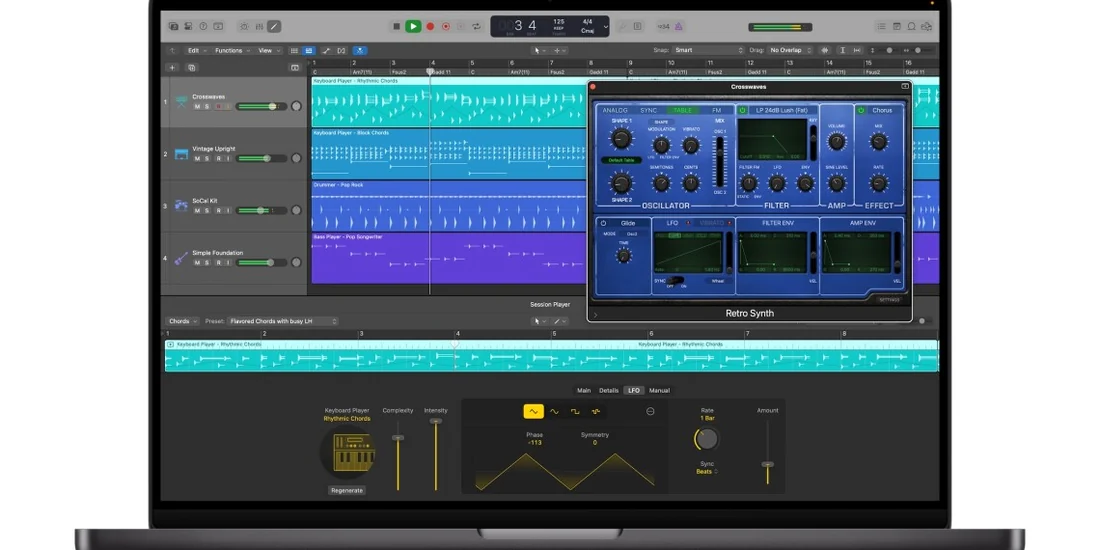
On 7 May 2024 Apple announced a set of AI features for Logic Pro: two Session Players, Bass Player and Keyboard Player, a Stem Splitter, and an expanded Chord Track workflow. The announcement states Bass Player was 'trained in collaboration with today's best bass players' and offers eight instrument options with controls for complexity and intensity, while Keyboard Player provides four styles 'designed in cooperation with top studio musicians'. Stem Splitter separates a mixed recording into drums, bass, vocals and other instruments, processed on the device itself.
What the documents say
The current product page, read as a living document on 16 September 2026, describes the players as following a Chord Track a user edits directly, and adds a companion feature, Chord ID, which 'pulls the chords from MIDI and audio regions and drops them in the Chord Track' so a player can follow an existing recording. Apple's user guide documents each player type separately, with dedicated pages for editing a Bass Player or Keyboard Player performance after it is generated, confirming the parts are editable MIDI regions rather than a fixed audio bounce. Neither document states what recordings, if any, informed the underlying model beyond 'trained in collaboration with' named musicians; no training-data disclosure is made.
Why it matters for makers
The mechanism worth separating is generation from arrangement. A Session Player proposes a performance against a chord progression a human still sets, and that performance arrives as editable MIDI notes, not a finished audio part. That is a different proposition from a text-to-song service returning a mixed audio file: here the harmonic decisions, form and final take remain the producer's, and the player behaves more like a sampled-performance layer than an autonomous composer. Stem Splitter raises a separate question, since it operates on any imported recording, including one the user does not own outright.
What to check before you use it
Confirm which chord progression the player is actually reading, since Chord ID derives it automatically from existing audio or MIDI and can misread ambiguous harmony. Check whether a generated bass or keyboard part is kept as an editable MIDI region or bounced early to audio, since that affects how much control survives into the final mix. For Stem Splitter, verify you hold rights to the source recording before separating and reusing its parts commercially; this is editorial guidance, since neither document addresses third-party recordings. None of this is legal advice.
- Is the chord progression the player follows one you set deliberately, or one Chord ID inferred?
- Do you still hold the generated part as editable MIDI, or has it already become fixed audio?
- Do you have the rights to split and reuse the specific recording you feed into Stem Splitter?
A session player inside a DAW is best read as an instrument choice, not a substitute for arranging: it plays what the chord track tells it to, and the producer who edits that track still does the composing.
Sources & reading trail
Apple's own announcement dating and describing Session Players, Stem Splitter and the training/collaboration claims.
Source published: 7 May 2024 · Retrieved: 16 September 2026
Living product page describing Chord Track, Chord ID and Stem Splitter as retrieved 16 September 2026.
Source published: Not established · Retrieved: 16 September 2026
Confirms each Session Player type has a dedicated documentation page for editing its generated performance.
Source published: Not established · Retrieved: 16 September 2026
Papers, terms and official documents establish the record; the maker reading and the checks are Signal to Song editorial analysis. This retrospective draft does not imply the site published on the event date.
Continue reading
- Open source made stem separation common but not a rights grant
- Browse the complete the archive
Sources & reading trail
- Logic Pro takes music making to the next level with new AI features
Source published: May 7, 2024 · Retrieved: September 16, 2026 - Logic Pro
Retrieved: September 16, 2026 - Logic Pro User Guide
Retrieved: September 16, 2026
The documents above establish the record. The reading and the questions are this publication’s editorial analysis, written after the fact.
Published September 18, 2026, not on the date of the event described.