A mental-health charity credited AI, not estates, for four songs
The campaign's own FAQ says an AI algorithm learned from 27 Club musicians' catalogues, while disclaiming estate endorsement.
- Historical event
- April 1, 2021
- First source published
- March 2, 2021
- Site publication
- September 18, 2026
What happened
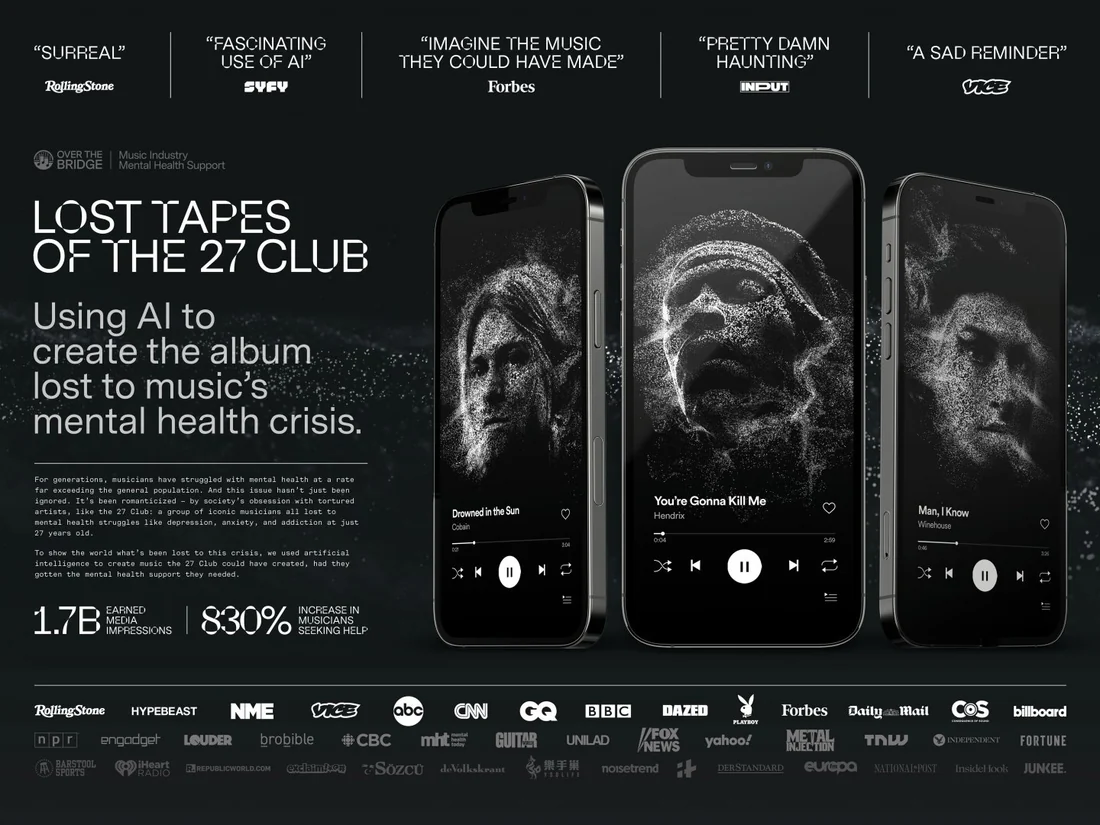
In April 2021 the Canadian music-industry mental health charity Over the Bridge published Lost Tapes of the 27 Club, a campaign built around four new songs credited to musicians who died at 27. The campaign's own site states plainly: "We had an artificial intelligence (AI) algorithm listen to isolated hooks, rhythms, melodies, and lyrics of 27 Club musicians," which then "generated a string of all-new hooks, rhythms, melodies, and lyrics." Over the Bridge's own event page confirms the charity organised an accompanying broadcast, Lost Tapes Live, with musicians and mental health professionals discussing the connection between the two.
What the documents say
The campaign's FAQ explains the choice of artists narrowly: "to allow the AI to be as accurate as possible, we chose 27 Club artists with a large catalogue of songs for the algorithm to learn from," a practical constraint stated as the selection criterion, not an artistic one. The same FAQ draws the rights line directly: "Lost Tapes of the 27 Club is in no way endorsed by or affiliated with 27 Club artists or their estates," and states that proceeds support musicians and industry professionals struggling with mental health through Over the Bridge. The site does not name which specific singers or musicians performed or produced the finished tracks, only that the AI supplied the compositional elements; this record does not add a vocal credit that the campaign's own materials do not give.
Why it matters for makers
The mechanism worth separating is training-data selection from creative selection: the campaign chose artists partly because their catalogues were large enough to train a model reliably, a data-availability constraint that shaped which four deceased musicians a listener hears evoked at all. The disclaimer distinguishes a copyright licence from a right of publicity or estate consent; the campaign secured neither, resting instead on charitable purpose and the transformative, style-referencing nature of new compositions rather than sampled recordings.
What to check before you use it
A maker attempting a similar tribute should check, and disclose, exactly what a generative process learned from and what a credited disclaimer actually covers: "not affiliated with the estate" is a statement about endorsement, not a claim about the underlying legal risk of using a deceased artist's stylistic likeness commercially. Whether new lyrics and melody "in the style of" a specific dead musician require estate consent varies by jurisdiction and is not something either of the campaign's own pages addresses. This is an editorial flag, not a conclusion the sources draw.
- Was an artist's catalogue chosen for training-data availability, or for the story being told about them?
- Does a disclaimer of estate endorsement also function as a disclaimer of legal risk, or only of affiliation?
- Are the human performers, singers, producers, engineers, on a finished track credited anywhere in the campaign's materials?
Lost Tapes of the 27 Club is a useful case for what its own materials choose to state and what they leave unstated: a clear account of training data and purpose, and silence on exactly who performed the results and what a "not affiliated" disclaimer does or does not protect against.
Sources & reading trail
Campaign's own FAQ describing the AI training method, artist-selection criteria and the estate-affiliation disclaimer.
Source published: Not established · Retrieved: 16 September 2026
Confirms Over the Bridge organised the campaign and its companion broadcast, with named human performers and hosts.
Source published: 2 March 2021 · Retrieved: 16 September 2026
Papers, terms and official documents establish the record; the maker reading and the checks are Signal to Song editorial analysis. This retrospective draft does not imply the site published on the event date.
Continue reading
- A voice clone’s consent has to satisfy a statute and a platform
- Get a license or do not sample, a court held in 2005
- Browse the complete the archive
Sources & reading trail
- Lost Tapes of the 27 Club
Retrieved: September 16, 2026 - Lost Tapes Live
Source published: March 2, 2021 · Retrieved: September 16, 2026
The documents above establish the record. The reading and the questions are this publication’s editorial analysis, written after the fact.
Published September 18, 2026, not on the date of the event described.