A neural codec's tokens explain a generator's sonic signature
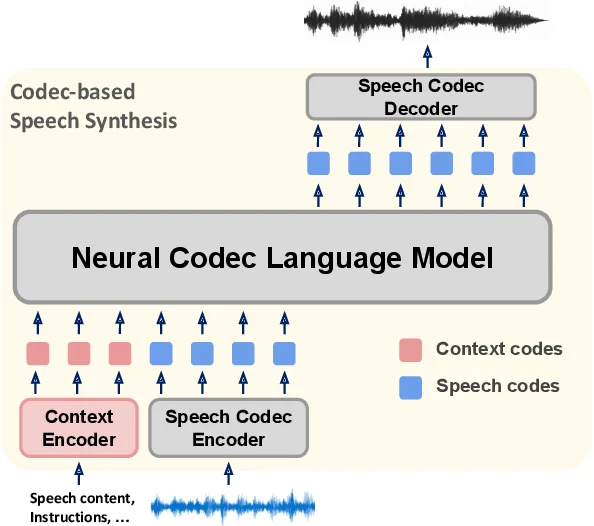
EnCodec compresses audio into discrete codes that generators like MusicGen predict, so the codec's decoder shapes the final sound.
- Historical event
- October 24, 2022
- First source published
- October 24, 2022
- Site publication
- September 18, 2026
What happened
On 24 October 2022, Meta researchers Alexandre Défossez, Jade Copet, Gabriel Synnaeve and Yossi Adi posted 'High Fidelity Neural Audio Compression' to arXiv, describing the codec later released as EnCodec. The paper presents a streaming encoder-decoder that compresses audio into a quantised stream of discrete codes rather than a waveform, trained end to end, and reports it judged superior to baseline codecs in subjective MUSHRA listening tests across speech, noisy speech and music. Code and pretrained models were published in the encodec repository.
What the documents say
The repository describes the architecture as a convolutional encoder feeding a residual vector quantiser, which produces several parallel streams, or codebooks, of discrete tokens, followed by a matching decoder; at 6 kbps the documentation states eight codebooks are used. The AudioCraft announcement, dated 2 August 2023, explains why this compression choice mattered beyond file size: it let Meta 'train autoregressive language models over these discrete audio tokens to generate new tokens and new sounds and music', with the resulting sequence decoded back to audio through EnCodec's own decoder.
Why it matters for makers
The mechanism explains a real, audible fact: when a generator like MusicGen makes music, it is not predicting a waveform, it is predicting the discrete codes a neural codec would have assigned to one, then handing those codes to that codec's decoder to become sound. Any characteristic timbral signature, compression artefact, or limitation of the specific codec and bitrate a model was trained against is therefore inherited by every track that model produces, in the same way a familiar MP3 encoder leaves its own signature on compressed audio.
What to check before you use it
If a generated track has a persistent sonic quality, a slight softness, a particular treatment of transients, it is worth asking whether that traces to the underlying neural codec rather than to the model's creative choices, since the codec is fixed at training time and reused for every output. This is an editorial inference beyond what either document claims directly: the papers describe the mechanism, not any specific model's audible signature, which would need its own listening comparison.
- Does the generator you are using state which neural codec, and at what bitrate, its tokens are decoded through?
- Is a recurring sonic quality in the output more likely a codec artefact than a deliberate creative parameter?
- Would a higher-bitrate or different codec, if the tool offers one, measurably change the result?
Naming the codec names the mechanism: a generator built on token prediction sounds the way its codec's decoder renders those tokens. That is a specific, checkable claim the source papers support, not a general statement about AI music sounding a particular way.
Sources & reading trail
Describes the EnCodec architecture, its discrete code output, and reports MUSHRA listening-test results.
Source published: 24 October 2022 · Retrieved: 16 September 2026
Documents the residual vector quantiser, codebook counts per bitrate, and extraction of discrete codes for downstream tasks.
Source published: Not established · Retrieved: 16 September 2026
States that MusicGen predicts EnCodec's discrete tokens and decodes them back to audio via EnCodec's decoder.
Source published: 2 August 2023 · Retrieved: 16 September 2026
Papers, terms and official documents establish the record; the maker reading and the checks are Signal to Song editorial analysis. This retrospective draft does not imply the site published on the event date.
Continue reading
- Meta open-sourced MusicGen with a licensed dataset and an NC licence
- A generation metric adapted from images admits a moderate correlation
- Stable Audio switched from a licensed library to Creative Commons
- Browse the complete the archive
Sources & reading trail
- High Fidelity Neural Audio Compression
Source published: October 24, 2022 · Retrieved: September 16, 2026 - encodec (Meta AI Research)
Retrieved: September 16, 2026 - AudioCraft: A simple one-stop shop for audio modeling
Source published: August 2, 2023 · Retrieved: September 16, 2026
The documents above establish the record. The reading and the questions are this publication’s editorial analysis, written after the fact.
Published September 18, 2026, not on the date of the event described.