NSynth shipped as an open dataset and model, not just a demo
Google's Magenta team published the NSynth paper, dataset and code together, letting musicians inspect and rebuild the instrument.
- Historical event
- April 6, 2017
- First source published
- April 5, 2017
- Site publication
- September 18, 2026
What happened
On 6 April 2017, Google's Magenta research group announced NSynth, a neural network approach to synthesising sound. The team's own announcement states what made the release unusual: 'unlike a traditional synthesizer which generates audio from hand-designed components like oscillators and wavetables, NSynth uses deep neural networks to generate sounds at the level of individual samples.' The model generated audio sample by sample, learned from recordings rather than specified by an engineer.
What the documents say
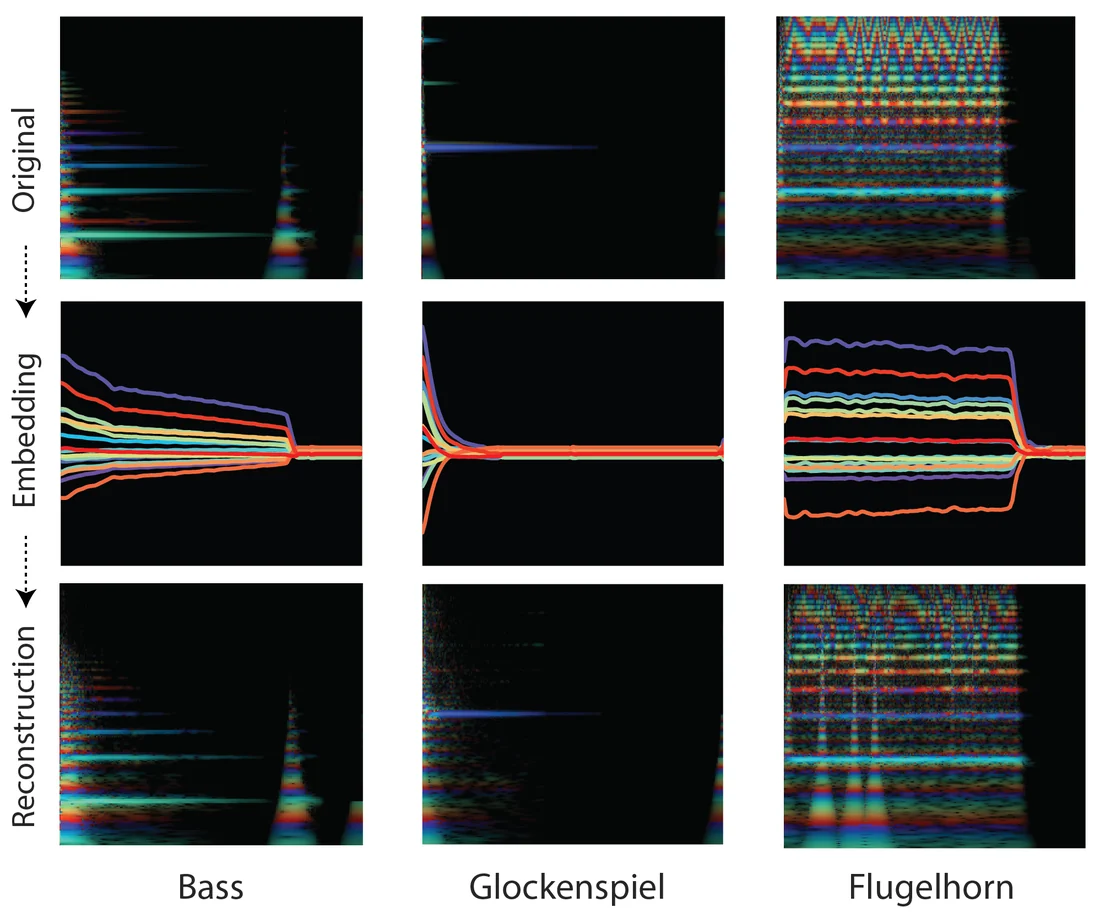
The announcement and the accompanying arXiv paper, submitted the day before, describe a WaveNet-style autoencoder trained on a purpose-built dataset the team also released: roughly 300,000 individual notes sampled from about 1,000 instruments, which the announcement calls 'an order of magnitude larger than comparable public datasets.' The paper's contribution is a learned temporal embedding, a compact numerical description of an instrument's timbre and dynamics that the network can interpolate between. The paper's abstract states that blending two embeddings creates a sound that combines semantic aspects of the two original sounds into 'a unique sound that is still musical', rather than simply layering two instruments' audio together. Critically, Magenta released the dataset, the trained model checkpoints, and code for generating new embeddings from a musician's own audio, not only a description of results or a closed demo.
Why it matters for makers
The mechanism worth naming, timbre represented as a continuous, interpolatable space rather than a fixed preset list, is what separates this kind of instrument from a conventional synthesiser's morph function. A conventional morph crossfades two sounds; an interpolated embedding produces a genuinely new timbre positioned between the two source instruments in a learned space, a different creative object. Because Magenta published the training code and weights rather than only a product, a producer or instrument builder could inspect, retrain or extend the model rather than treat it as a fixed black box, unlike a commercial plugin released without its training data or weights.
What to check before you use it
A maker working with any descendant of this approach can check whether that tool's own documentation discloses what training data produced its sound space, since the announcement is explicit that the acoustic qualities of the learned instrument 'depend on both the model used and the available training data.' A tool trained on an unpublished, undisclosed corpus offers no equivalent way to reason about what timbres it can and cannot represent well. This is an editorial inference drawn directly from Magenta's own framing of that dependency.
- Does the instrument I am using disclose its training data, even in general terms, the way the NSynth paper does?
- Am I treating an interpolated or generated timbre as a new instrument in its own right, rather than expecting it to substitute for a specific real one?
- If I build on open code and weights, have I checked the licence terms attached to both, since they can differ?
NSynth's significance was not only the sound it made but what Magenta chose to publish alongside it: a dataset, a paper, and working code, together making the mechanism inspectable rather than only demonstrable.
Sources & reading trail
Magenta's own announcement dates NSynth's release, describes the WaveNet-style autoencoder, and states the released dataset's size relative to prior public datasets.
Source published: 6 April 2017 · Retrieved: 16 September 2026
The paper's abstract describes the autoencoder architecture and the timbre/dynamics latent space the interpolation relies on.
Source published: 5 April 2017 · Retrieved: 16 September 2026
Confirms Magenta's continued open-source release model for musician-facing tools, retrieved 16 September 2026.
Source published: Not established · Retrieved: 16 September 2026
Papers, terms and official documents establish the record; the maker reading and the checks are Signal to Song editorial analysis. This retrospective draft does not imply the site published on the event date.
Continue reading
- WaveNet generated raw audio, and then music, sample by sample
- MusicLM was published with its memorisation study attached
- A hobby fine-tune turned an image model into a music one
- Browse the complete the archive
Sources & reading trail
- NSynth: Neural Audio Synthesis
Source published: April 6, 2017 · Retrieved: September 16, 2026 - Neural Audio Synthesis of Musical Notes with WaveNet Autoencoders
Source published: April 5, 2017 · Retrieved: September 16, 2026 - Magenta
Retrieved: September 16, 2026
The documents above establish the record. The reading and the questions are this publication’s editorial analysis, written after the fact.
Published September 18, 2026, not on the date of the event described.