MusicLM was published with its memorisation study attached
Google's text-to-music paper reported a duplication test and withheld the model for over three months.
- Historical event
- January 26, 2023
- First source published
- January 26, 2023
- Site publication
- September 18, 2026
What happened
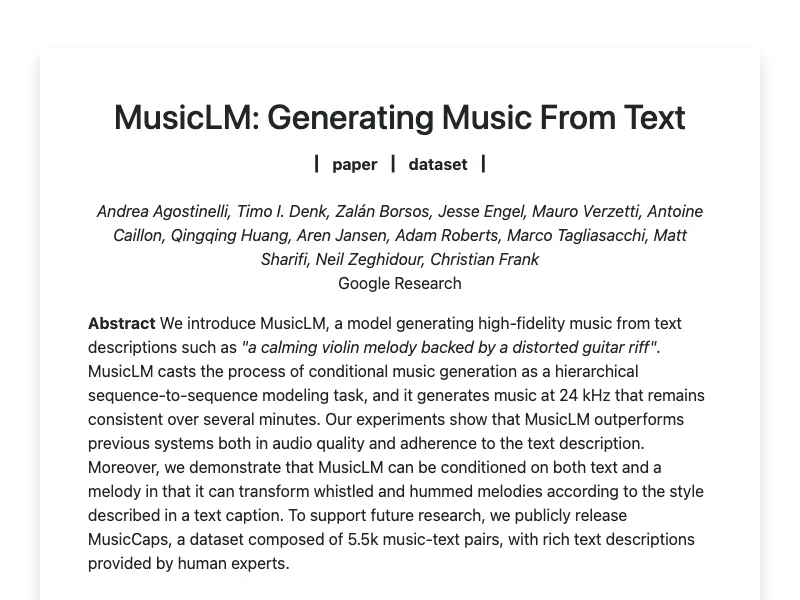
Google Research submitted the MusicLM paper to arXiv on 26 January 2023, describing a system generating 'high-fidelity music from text descriptions such as "a calming violin melody backed by a distorted guitar riff"'. The paper reports a model trained on five million audio clips totalling 280,000 hours of music, modelled hierarchically so a description turns into audio that stays coherent for several minutes. The paper alone was a research artefact: it took until 10 May 2023 for Google's announcement to open a limited version inside AI Test Kitchen, on web, Android and iOS.
What the documents say
The paper is unusually specific about a risk most contemporaries left unexamined: it reports testing how often MusicLM's output reproduces training data, finding exact matches in under 0.2% of generations and closer approximate matches in around 1%, and states plainly, 'we have no plans to release models at this point', citing the risk of misappropriating creative content. That sentence is why MusicLM is remembered as a withheld model rather than a shipped one for over three months. The May announcement changes the object under discussion: it offers two song versions per text prompt inside a sign-up product, framed throughout as experimental, describing workshops with musicians including Dan Deacon rather than an unrestricted release of the model. The examples page demonstrates capabilities the paper claims, including a 'story mode' chaining prompts into a continuing piece and melody conditioning from a hummed input, without new claims about training or release terms.
Why it matters for makers
The mechanism to hold onto is the separation between a capability and a release decision. MusicLM's model was reportedly capable well before the public could prompt it, and the gap between the January paper and the May product was explained by the authors as a deliberate withholding on creative-rights grounds, not a technical delay. That distinction matters whenever a maker evaluates a system announced only through a paper: a described capability is not an available tool, and a published risk analysis is a more reliable signal of what comes next than a demo video.
What to check before you use it
Before treating any text-to-music system as MusicLM-class, check whether the vendor has published its own memorisation testing the way this paper did, since a bare quality claim tells a maker nothing about copying risk. Check also whether a public version is the model discussed in a paper, or a distinct, restricted variant released later, as AI Test Kitchen's MusicLM was. This is an editorial checklist, not a rule either document states.
- Has the vendor published a memorisation or duplication study, or only a quality benchmark?
- Is the product available today the same model described in the paper, or a later, separately governed variant?
- What reason, if any, has the vendor given for withholding or restricting a capability it has already demonstrated?
MusicLM's lasting significance is procedural: it is one of the few systems here where the people who built it published their own reason for not shipping it immediately, a higher bar than most of what followed was held to.
Sources & reading trail
Paper text reporting the 280,000-hour training set, the memorisation study (under 0.2% exact matches) and the statement of no plans to release the model.
Source published: 26 January 2023 · Retrieved: 16 September 2026
Confirms the 10 May 2023 AI Test Kitchen release, its experimental framing, and musician workshops including Dan Deacon.
Source published: 10 May 2023 · Retrieved: 16 September 2026
Demonstrates story mode and melody-conditioning capabilities described in the paper.
Source published: Not established · Retrieved: 16 September 2026
Papers, terms and official documents establish the record; the maker reading and the checks are Signal to Song editorial analysis. This retrospective draft does not imply the site published on the event date.
Continue reading
- Jukebox generated singing from raw audio and stayed a demo
- Meta open-sourced MusicGen with a licensed dataset and an NC licence
- Open models show two ways to disclose training data
- Browse the complete the archive
Sources & reading trail
- MusicLM: Generating Music From Text
Source published: January 26, 2023 · Retrieved: September 16, 2026 - MusicLM: Generating music from text, now available in AI Test Kitchen
Source published: May 10, 2023 · Retrieved: September 16, 2026 - MusicLM examples
Retrieved: September 16, 2026
The documents above establish the record. The reading and the questions are this publication’s editorial analysis, written after the fact.
Published September 18, 2026, not on the date of the event described.