Jukebox generated singing from raw audio and stayed a demo
OpenAI's two music systems show a research trajectory from MIDI notes to raw audio, released with unusually candid limitations.
- Historical event
- April 30, 2020
- First source published
- April 25, 2019
- Site publication
- September 18, 2026
What happened
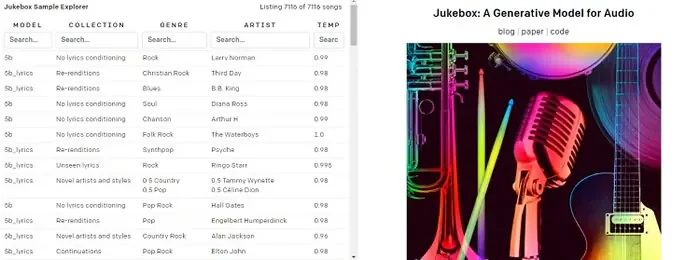
OpenAI published two music-generating systems in successive years. MuseNet, released 25 April 2019, predicted the next token in hundreds of thousands of MIDI files and could produce four-minute compositions across ten instruments, blending styles from Mozart to the Beatles in one generation. A year later, on 30 April 2020, OpenAI released Jukebox, described in the paper as a model generating music, 'including rudimentary singing, as raw audio'. Where MuseNet worked on symbolic notes, Jukebox modelled the audio waveform itself, trained on a crawled dataset of 1.2 million songs, 600,000 in English, paired with lyrics and metadata from LyricWiki.
What the documents say
The release page states Jukebox lets a user steer generation with an artist, a genre and a block of lyrics, and that the model learns, unsupervised, 'to cluster similar artists and genres close together' - how it imitates a named performer's style rather than a generic one. The page is candid about the gap between this and a finished song: limitations include the absence of familiar repeating choruses, audible noise from compression, and a render time of roughly nine hours per minute, which the authors say rules out interactive use. MuseNet's page adds a related caveat: requested instruments are 'strong suggestions, not requirements', since the model predicts probabilities across all notes and instruments rather than enforcing a hard constraint. Together the pages describe a trajectory from symbolic notes to raw waveform, not a stable product.
Why it matters for makers
The distinction that matters is between conditioning and consent. Jukebox's artist tag is a label attached to training examples, not an agreement with the performer named, and the page does not claim otherwise. A generation prompted with a living artist's name is a style imitation built from a metadata tag, not a licensed collaboration - a different object before a note is even compared to a recording. The page records that OpenAI shared the model with ten musicians ahead of publication, who did not find it 'immediately applicable to their creative process' - a reminder that a landmark result and a usable instrument are not the same claim.
What to check before you use it
Anyone tracing today's text-to-song tools to this lineage should check what the dataset was, a web crawl paired with lyric-site metadata rather than a disclosed licensed catalogue, and what the model was conditioned on, named artists and genres rather than consented performances. This is an editorial reading of the gap, not a claim either paper makes about the other.
- Does a system's documentation name its training sources, or only describe how they were gathered?
- Is an artist name in a prompt a licensed style or an unlicensed label learned from a crawl?
- Has a later paper in the same lineage addressed a risk, such as memorisation, that this one leaves open?
Jukebox and MuseNet are a hinge in the record: proof that raw audio generation with a recognisable voice was reachable in 2020, published alongside limitations candid enough to explain why it took years before a version of this became something a producer could put in a session.
Sources & reading trail
OpenAI's own description of MuseNet's MIDI training data, instrument conditioning and stated limitations.
Source published: 25 April 2019 · Retrieved: 16 September 2026
Describes Jukebox's dataset (1.2 million crawled songs, LyricWiki metadata), artist/genre conditioning, and documented limitations including render time and musician feedback.
Source published: 30 April 2020 · Retrieved: 16 September 2026
Peer paper confirming the raw-audio, hierarchical VQ-VAE and transformer approach and its ability to condition on artist, genre and lyrics.
Source published: 30 April 2020 · Retrieved: 16 September 2026
Papers, terms and official documents establish the record; the maker reading and the checks are Signal to Song editorial analysis. This retrospective draft does not imply the site published on the event date.
Continue reading
- MusicLM was published with its memorisation study attached
- Open models show two ways to disclose training data
- A hobby fine-tune turned an image model into a music one
- Browse the complete the archive
Sources & reading trail
- MuseNet
Source published: April 25, 2019 · Retrieved: September 16, 2026 - Jukebox
Source published: April 30, 2020 · Retrieved: September 16, 2026 - Jukebox: A Generative Model for Music
Source published: April 30, 2020 · Retrieved: September 16, 2026
The documents above establish the record. The reading and the questions are this publication’s editorial analysis, written after the fact.
Published September 18, 2026, not on the date of the event described.