A settlement turned Suno into Warner's licensed AI platform
WMG and Suno's own statements describe a litigation settlement and an opt-in framework, without yet naming a participating artist.
- Historical event
- November 25, 2025
- First source published
- November 25, 2025
- Site publication
- September 18, 2026
What happened
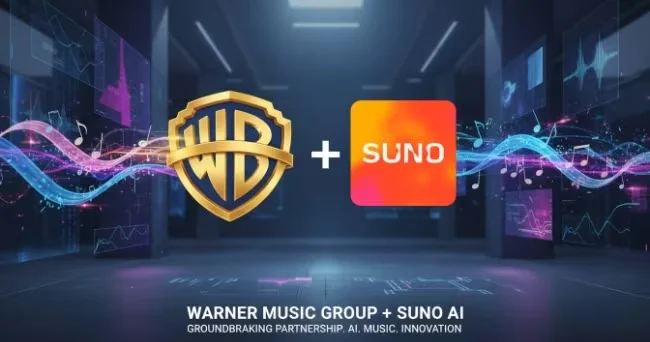
On 25 November 2025, Warner Music Group and Suno announced what both companies' own statements call a "first-of-its-kind partnership". WMG's press release states the deal "settles previous litigation between the companies", a reference to WMG's participation in the major labels' copyright suit against Suno. Suno's own announcement frames the same deal as opening "a bigger, richer Suno experience", and both companies confirm Suno has separately acquired the concert-discovery platform Songkick from WMG as part of the arrangement.
What the documents say
WMG's chief executive Robert Kyncl is quoted defining what "pro-artist" AI means to the company: "committing to licensed models, reflecting the value of music on and off platform, and providing artists and songwriters with an opt-in for the use of their name, image, likeness, voice and compositions in new AI songs." Suno's chief executive Mikey Shulman is quoted describing "opportunities to collaborate and interact with some of the most talented musicians in the world." Both statements describe structural changes for 2026: new licensed models will replace Suno's current ones, free-tier downloads will end, and paid-tier downloads will carry caps. Neither statement names a single WMG artist who has opted in, what percentage of revenue reaches them, or when the opt-in feature itself will ship; WMG's release says only that "artists and songwriters will have full control over whether and how" their names, images, likenesses, voices and compositions are used.
Why it matters for makers
The mechanism worth separating is a corporate licensing framework from an individual artist's actual participation. A settlement between a label and a generator establishes that the generator may license the label's catalogue on agreed terms; it does not, by itself, tell a songwriter or session musician on that roster whether their own voice will be offered for AI use, on what split, or with what veto. For a working musician signed to a major label, the practical question is not whether the company has a policy, but whether and how an individual artist's own consent will be sought before their voice appears in a generated song.
What to check before you use it
An artist or songwriter under a major label should ask, specifically, whether "opt-in" means an affirmative choice sought from them individually, and check any subsequent contract addendum or platform notice for the actual revenue share, rather than relying on a press release's general language. A listener or maker building on a "participating artist's sounds", in Suno's own phrase, should look for the same specifics before assuming a given voice or style is licensed. This is an editorial checklist; neither company's statement yet supplies these details.
- Has a specific artist actually opted in, or does the announcement describe a framework with no participants named yet?
- What percentage of revenue from an opt-in use reaches the artist, and is that written into their own contract?
- Does "full control" mean consent sought per use, or a single blanket agreement covering future uses?
The WMG-Suno announcement is best read as a corporate settlement and licensing framework, stated in the companies' own words, rather than as evidence that any particular artist's voice is now available for AI-generated music; as of these statements, none had been named.
Sources & reading trail
WMG's own press release: litigation settlement, opt-in framework quotes from Robert Kyncl, 2026 platform changes, Songkick acquisition.
Source published: 25 November 2025 · Retrieved: 16 September 2026
Suno's own announcement of the same partnership, with CEO Mikey Shulman's quote on the platform's direction.
Source published: 25 November 2025 · Retrieved: 16 September 2026
Papers, terms and official documents establish the record; the maker reading and the checks are Signal to Song editorial analysis. This retrospective draft does not imply the site published on the event date.
Continue reading
- Record labels sued Suno and Udio over training data
- Warner Music settled with Suno for a licensed platform
- Suno assigns song ownership only on its paid tiers
- Browse the complete the archive
Sources & reading trail
- Warner Music Group and Suno Forge Groundbreaking Partnership
Source published: November 25, 2025 · Retrieved: September 16, 2026 - A new chapter in music creation
Source published: November 25, 2025 · Retrieved: September 16, 2026
The documents above establish the record. The reading and the questions are this publication’s editorial analysis, written after the fact.
Published September 18, 2026, not on the date of the event described.