Two voice-conversion services now publish artist consent as a feature
Kits AI and Voice-Swap market artist-approved voice libraries, but their own terms put the consent burden for uploaded voices on the user.
- Site publication
- September 18, 2026
What happened
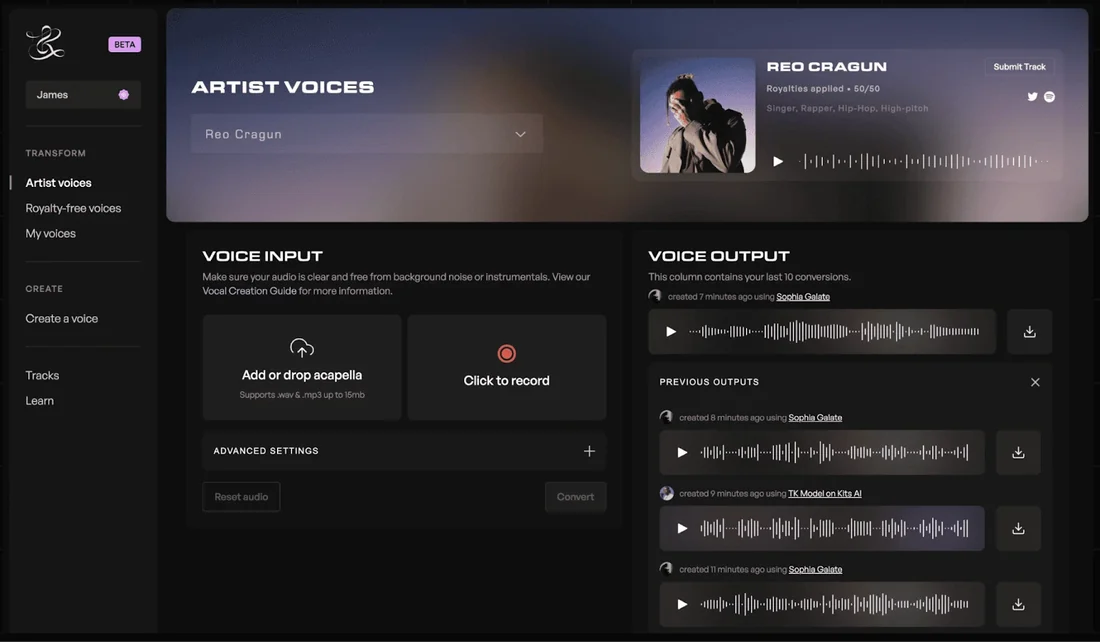
Kits AI and Voice-Swap are two commercial voice-conversion services that, as retrieved on 16 September 2026, market themselves around artist consent rather than open cloning. Kits AI's own homepage states that 'every voice used in our models is ethically licensed and securely sourced by Kits via the artists themselves', and describes a programme called Kits Earn through which artists who contribute a voice model receive a share of its use. Voice-Swap's business page describes its custom voice offering as built 'from authorised recordings' with rights 'secured' and models 'contract-backed from inception'. Both frame licensed sourcing as their point of difference from open-source cloning tools.
What the documents say
Kits AI's terms of service distinguish a pre-built library of licensed voices from custom models a user creates from their own uploaded audio. For custom models, the terms require the user to represent they hold 'all rights, licenses, consents, permissions' needed for any voice file they submit, and separately prohibit using the service to 'impersonate somebody... without their authorization'. The terms do not themselves document how the pre-built library's artist licences were obtained; that claim appears only on the marketing homepage, not in the contractual document. Voice-Swap's business page similarly asserts that ownership and licensing are 'confirmed in writing before you commit', without publishing the licence text or a royalty figure.
Why it matters for makers
The mechanism worth separating here is marketing claim versus contractual obligation. A platform's homepage can describe an ethics programme while its terms of service place the actual, enforceable consent burden mainly on the end user for anything they upload themselves — the pre-built library's clearance is asserted, not demonstrated, in the document a user actually agrees to. That gap matters commercially: if a rights dispute arose over a library voice, the user's protection depends on representations made outside the contract they signed.
What to check before you use it
Before releasing a commercial track built on a pre-built library voice, a maker should ask the platform directly for the licence or consent record behind that specific voice, rather than relying on homepage language; confirm what 'ethically licensed' covers — the recording, the likeness, or both; and, for any custom model built from someone else's voice file, keep the uploader's own written consent, since the terms of service assign that responsibility to the uploader, not the platform.
- Does the platform's contract, not just its marketing page, document artist consent for library voices?
- What happens contractually if a library voice's clearance is later disputed?
- For a custom model, is there a signed consent record from the voice's actual owner?
Ethically-sourced marketing language is a reasonable signal of intent, but the enforceable document is the terms of service, and on both services reviewed here that document is narrower than the homepage claim sitting beside it.
Sources & reading trail
The contractual terms: custom-model ownership assignment, output licence, and the user's consent representations.
Source published: Not established · Retrieved: 16 September 2026
The company's own marketing claim that library voices are 'ethically licensed' and its Kits Earn revenue-share programme.
Source published: Not established · Retrieved: 16 September 2026
The platform's own description of licensing custom voices from authorised recordings, contract-backed from inception.
Source published: Not established · Retrieved: 16 September 2026
Papers, terms and official documents establish the record; the maker reading and the checks are Signal to Song editorial analysis. This retrospective draft does not imply the site published on the event date.
Continue reading
- An open-source voice cloner ships with no consent gate at all
- A voice clone’s consent has to satisfy a statute and a platform
- Browse the complete the archive
Sources & reading trail
- Kits AI Terms of Service
Retrieved: September 16, 2026 - Kits AI
Retrieved: September 16, 2026 - Voice-Swap for Business
Retrieved: September 16, 2026
The documents above establish the record. The reading and the questions are this publication’s editorial analysis, written after the fact.
Published September 18, 2026, not on the date of the event described.