Hatsune Miku launched as a commercial voice bank with a licence
Crypton Future Media's own materials date Hatsune Miku's release and show the character and voice rights were licensed in separate stages.
- Historical event
- August 31, 2007
- Site publication
- September 18, 2026
What happened
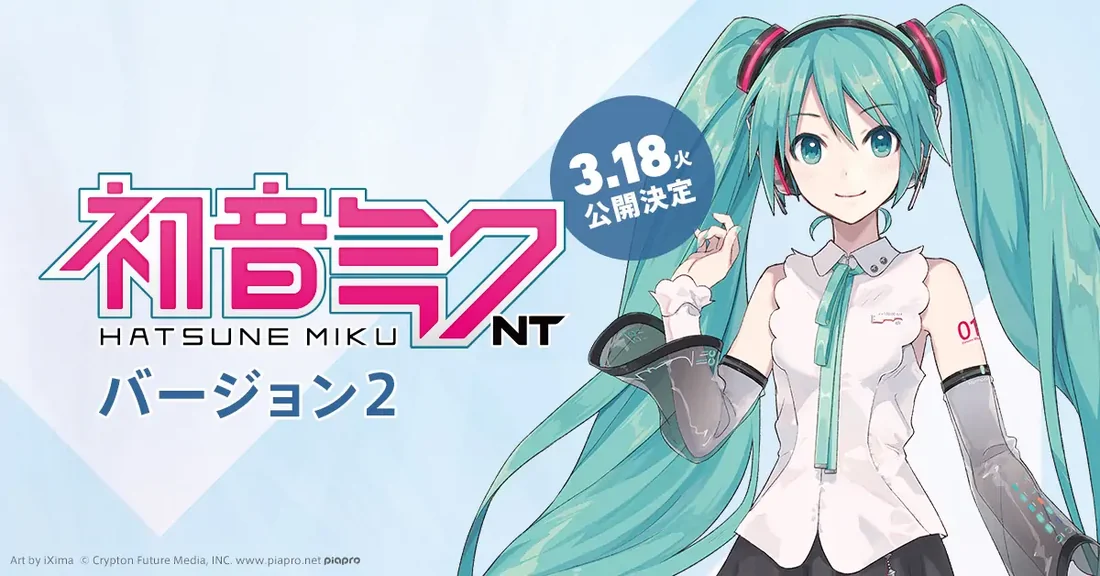
On 31 August 2007, Crypton Future Media, a music technology company based in Sapporo, released Hatsune Miku, a singing-voice synthesizer built on Yamaha's VOCALOID engine. The company's own English-language product page states that Miku 'was developed by Crypton Future Media, Inc. in Sapporo, Japan, and released on August 31st, 2007,' running on technology described as 'Powered by YAMAHA's VOCALOID (=Vocal + Android) technology.' Unlike a plug-in or sample library sold under a generic end-user agreement, Miku shipped as a named, illustrated character with a voice bank a buyer purchased and used inside a dedicated editor, not a model a user trained.
What the documents say
Yamaha's current VOCALOID site confirms VOCALOID remains a Yamaha trademark and that voice banks, the licensed data packages a synthetic singer's voice ships as, are sold individually across successive engine versions. That commercial voice-bank structure was present from Miku's 2007 release. The character and image side of the rights picture came later, and separately: Piapro's creator guidance states that Crypton's own Piapro Character License 'was publicly announced in 2009,' two years after release, giving fan creators explicit permission for derivative character art. A further Crypton product page adds that the company applied a Creative Commons CC BY-NC licence to Miku's original illustrations starting in 2012. Three documents therefore describe three distinct rights layers, the purchased voice bank, the 2009 character licence, and the 2012 Creative Commons grant for artwork, arriving in stages rather than as one bundled agreement.
Why it matters for makers
The mechanism worth naming is the separation between a voice-bank licence, which governs synthesising new performances, and a character licence, which governs drawing or depicting Miku herself. A producer who buys a voice bank has permission to generate singing; that says nothing about whether an accompanying illustration, video or merchandise use of the character is separately licensed. Treating 'I bought the software' as clearance for every downstream use of the character conflates grants Crypton itself keeps distinct.
What to check before you use it
Before releasing a track or video built around a licensed synthetic voice, a maker can identify which specific licence covers each element in use, the voice synthesis itself, any character artwork, and any packaging or promotional imagery, and read that licence's current terms rather than assume one licence covers all three. This is an editorial checklist drawn from the separate licences Crypton documents, not a substitute for reading the operative terms Piapro's own page says govern the PCL.
- Does my use involve the synthesised voice, the character's image, or both, and is each one licensed?
- Am I relying on the Creative Commons grant, the Piapro Character License, or a separate commercial agreement?
- Has the licence text changed since I last checked, given these are living documents the rights holder maintains?
Hatsune Miku is often described as software that became a star; the documents describe something more specific, a voice bank, a character, and a set of licences that arrived in stages and still have to be read separately today.
Sources & reading trail
Crypton's own page states Hatsune Miku's developer, the underlying VOCALOID technology, and the 31 August 2007 release date.
Source published: Not established · Retrieved: 16 September 2026
States the Piapro Character License was publicly announced in 2009 and operates alongside Crypton's Creative Commons licensing for fan works.
Source published: Not established · Retrieved: 16 September 2026
Confirms Yamaha's ownership of the VOCALOID trademark and describes the current voice-bank purchase and licensing model.
Source published: Not established · Retrieved: 16 September 2026
States Crypton adopted a Creative Commons CC BY-NC licence for Hatsune Miku's original illustrations beginning in 2012.
Source published: Not established · Retrieved: 16 September 2026
Papers, terms and official documents establish the record; the maker reading and the checks are Signal to Song editorial analysis. This retrospective draft does not imply the site published on the event date.
Continue reading
- A character licence, not a contract, built Miku's fan economy
- Two voice-conversion services now publish artist consent as a feature
- Open models show two ways to disclose training data
- Browse the complete the archive
Sources & reading trail
- About HATSUNE MIKU (archived Crypton Future Media page)
Retrieved: September 16, 2026 - For Creators (Piapro Character License)
Retrieved: September 16, 2026 - VOCALOID official site
Retrieved: September 16, 2026 - Hatsune Miku V2 product page
Retrieved: September 16, 2026
The documents above establish the record. The reading and the questions are this publication’s editorial analysis, written after the fact.
Published September 18, 2026, not on the date of the event described.